Showing posts with label myths. Show all posts

Wednesday, January 15, 2014

Vampires, Vampyres. Tomato, Tomahto. Oh positive, they bite!


by Denise Golinowski

Hi! Welcome back to Myth Perceptions where I explore myths, fairy tales, fantasy, and mystical motifs. Lately, I've been drawn into several vampire series, in book and television formats, and it got me seriously reviewing my knowledge base on Vampires.


Research on the web revealed that my understanding is less than complete and that modern writers are, as they are wont to do, playing fast and loose with the established tropes. Spinning, stretching, morphing them into directions the original story-tellers would find unsettling and bedazzling--just before they dove in to put their own takes on same, I'm sure. It is a professional weakness.

The vampire that we all know and love is usually based upon the framework provided by Bram Stoker's Dracula--dead, blood-sucking, night-walker, sensitive to religious icons, and virtually immortal, etc. However, popular movies have raised this deadly hunter from a pasty-skinned recluse to a suave and debonair hunter-about-town. Indeed, vampires weren't always so very seductive. Oh, no, siree.

Dig a bit deeper in the family vault, and you'll find descriptions of a less appealing nature. Vampires were portrayed as bloated, ruddy-skinned, and sadly lacking in basic hygiene skills. And as for fashion sense, you could describe it as "none." Most early vampires staggered about the 18th century southeastern European neighborhood graveyard in their burial shroud.

Ah, and there's an interesting point--European. The popular vampire is based on the European model, but other cultures have older and unique bloodsuckers of their own. Spoiler--I'll be trotting them out in a later post or two.

The vampires of folklore were more home-bodies than world-travellers, preferring to visit, torment, and feed upon family and friends. Though they weren't above purloining a random bit of livestock and or small animals. Vampires were often the result of suicide, witch-hunts, or malevolent spirits taking a local corpse out for a little joyride.

Since visitors with such poor social skills were less than welcome, the locals went to great lengths to ensure that their deceased loved ones remained peacefully interred. One of the more quaint routines was to bury the dead face-down in the ground so that if they took a mind to dig themselves out, they'd actually only dig themselves deeper. Religious icons also featured heavily in burial rituals not only in respect of beliefs, but to remind the dead to remain dead.

Regretably, emotions about vampire sightings would run so high in places that corpses would be unearthed to be staked, beheaded, burned, and even hamstrung. Anyone acting suspicious might run afoul of a ravening mob and end up staked.

Well, like the inside of the lids of some exhumed coffins, I've only scratched the surface, so please, come back next month when I'll be delving deeper into the world of vampires.

Denise Golinowski is a reader and writer of fantasy and romance. Her newest enovella, Collector's Item, is available from  The Wild Rose Press.

Her first enovella, The Festival of the Flowers: The Courtesan and the Scholar is also available  through the Wild Rose Press. You can visit her blog at Golinowski's Gambol.

Thursday, October 17, 2013

Merrow, not meow - Mermaid Myths Continued

Hi! Thank you for dropping in to Myth Perceptions where I'm sharing with you various myths and legends I've discovered while researching for my fantasy writing!

Sorry I'm late posting this month, friends. Continuing my research into mermaid myths around the world, I actually encountered a new "to me" myth - the Irish Merrow, thanks to one of my fav paranormal authors, Seanan McGuire.


In "One Salt Sea", half-fae heroine, October Daye, helps solve a kidnapping case involving the two sons of a Merrow and land Fae. If you haven't read any of the October Daye series, you should give it a serious look. You'll learn a LOT about the fae and October is an amazing character! 


So, what's a Merrow? A Merrow is an Irish mermaid or merman. Like most of the merpeople around the world, merrow are human looking from the waist up, fish from the waist down. The Merrow have a comb parting their green hair along crest of their heads and pale webbing between their fingers. They always wear magical red caps made, interestingly enough, of feathers. The cap is called a cohuleen druith which enables them to dive beneath the waves to return to their homes. The merrow often leave the sea to travel about on land, sometimes as small hornless cows or as lovely women wrapped in red capes. Without their cohuleen druith, they are stuck on land, making the caps their weakness. (I could find no explanation for the reason a mermaid would need help to go beneath the waves, and why a feathered cap.)

It is also said that they appear before storms and can capsize boats with careless disregard for the humans on board. Such actions can range from playfulness to fits of rage, but their fae nature makes them naturally careless of weak mortals.

The mermaids are beautiful creatures and enjoy dallying with human males. In the water, they can be wild and careless, but on land, they are gentle and affectionate, making them excellent targets for fishermen seeking amenable wives. If the cohuleen druith is hidden away, the merrow must stay on land, but if she ever finds the cap, she is inexorably drawn to return to the water, abandoning husband and family, never to return. Even with this threat of possible enslavement, female merrows actively seek human lovers and will lure men under the waves to live in enchanted pleasure.

The mermen are far less attractive with red eyes, rosy piglike noses, and gross bodies. They are said to be overly partial to whisky, hence the red noses and eyes. (This might also explain why female merrows are trolling in human "waters" for lovers, eh?) They will also capture humans, but to serve as slaves.

In conclusion, the merrow seem to combine several mythic forms--mermaid, siren, selkie--into one intriguing package topped with a jaunty red feathered cap.

Next month, I'll conclude the mermaid series with some general observations and conclusions. Hope you'll drop by.

Denise Golinowski is a reader and writer of fantasy and romance. Her newest enovella, Collector's Item, is available from  The Wild Rose Press.


Her first enovella, The Festival of the Flowers: The Courtesan and the Scholar is also available  through the Wild Rose Press. You can visit her blog at Golinowski's Gambol.

Thursday, July 18, 2013

One Fish, Two Fish - Two Ancient Mermaid Myths

Hi! Thank you for dropping in to Myth Perceptions where I'm sharing various myths and legends I've discovered while researching for my fantasy writing, and for you!

For the next few months, I'll be exploring various myths about Mermaids.

Last month, I talked a little about Hans Christian Anderson's The Littlest Mermaid. While I was digging around my memories of the story and researching to find more details, I discovered a reference to two of the "first" mermaid myths--The Myth of Atargatis--and another similar myth about Thessalonike.

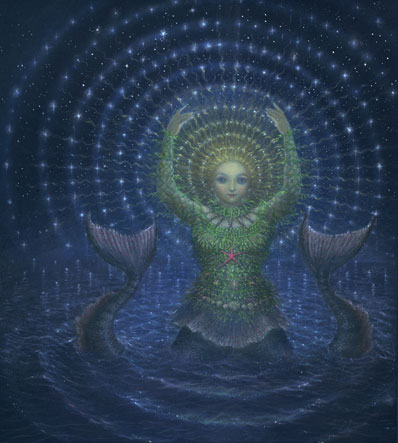
Image by Virginia Lee

Atargatis is a Syrian or Aramaic goddess. Several sources call her the mermaid goddess. She was a fertility and protective goddess. One popular myth involves her falling in love (or being cursed to love) a human male. When he dies (or disappears), she casts herself into a lake to become half-human/half-fish. Her followers will not eat fish nor doves (doves are sacred to her daughter).


Image Source - Greek Reporter
Thessalonike is another ancient mermaid myth however my research discovered that she was a historical figure who also has evolved into a myth. Historically, Thessalonike was half-sister to Alexander The Great. During her life, she went from near forgotten daughter to sequestered princess to Queen of Macedonia. It's a very convoluted story, but a fascinating read in the Wiki. The myth is Very Different.

It is said that Alexander the Great bathed his half-sister, Thessalonike's hair with water that would make her immortal. When he died, Thessalonike was so stricken with grief, she threw herself into the sea and became a mermaid. It was her tradition to inquire of passing ships: Is Alexander the King alive? Wise sailors would reply: He lives and reigns and conquers the world. Then she would let them pass. Those who did not reply properly would face her wrath in storm and shipwreck. 

I have to wonder why she would pose a question to which she knew the answer and then punish those who spoke the truth. Not very sporting of her.

I am fascinated by the fact that both of these "original" mermaid stories are not that far from Hans Christian Anderson's mermaid story. (Obviously he did his homework too, eh?) Both cast themselves into the sea to die, or transform and the impetus--love. If I can lead you one step further, I would offer the observation that the sea these female representations are throwing themselves into can be viewed as a representation of emotions (represented by the element of water). And they all lose themselves in the sea of their emotions, becoming something else all together. I leave it to you to decide if that's a good thing or a bad thing, for them or for us.

Well, I'll end it here and welcome your comments. Please come back next month when I'll be exploring another batch of mermaid myths here at Myth Perceptions.


Denise Golinowski is a reader and writer of fantasy and romance. Her newest enovella, Collector's Item, is available from  The Wild Rose Press


Her first enovella, The Festival of the Flowers: The Courtesan and the Scholar is also available  through the Wild Rose Press. You can visit her blog at Golinowski's Gambol.

Wednesday, April 17, 2013

Swanning About Swan Maidens


Hi! Denise Golinowski here with this month's edition of Myth Perceptions.

Continuing with the Shapeshifters World Tour, I've crossed the channel from Scotland to Eastern Europe to explore the myth of the Swan Maidens.

As with most myths we've explored before, there are a variety of swan maiden myths spread across various cultures from Scandanavia to Germany to Japan. However, the majority of myths about Swan Maidens appear to be European in origin.

Pixabay.com

The Swam Maiden myth usually involves lovely magical women wearing swan skins or robes who regularly descend to quiet, isolated pools to shed their feathers and splash about in the waters. They are discovered by a human intruder, and one is captured when the intruder takes possession of her feather skin/robe. As long as the human male holds the robe, the swan maiden must remain with him in human form. Eventually, someone spills the beans about the whereabouts of the robe or the swan maiden finds it. Once she regains possession of her robe, she flies away abandoning the man as well as any offspring they may have engendered.  Click the link beneath this image to read what I found to be one of the most popular versions of the Swan Maiden myth.

From Europa's Fairy Book

Pixabay.com
The myth is most popularly portrayed by the ballet, Swan Lake with one crucial difference. The  man and maiden in this ballet are truly in love and sacrifice themselves in order to stay together.

I especially enjoyed the variety of swan maiden stories contained on this website - http://www.pitt.edu/~dash/swan.html#contents. 

What I find intriguing about this and some of the other shapeshifting myths is how a magical creature could make themselves so vulnerable as to shed the key to their freedom and then leave it lying around where a covetous human can steal it away from them. I guess when you're a magical creature, you can be as careless as any human, but it seems odd.


If you remove the stupidity factor (sorry, shapeshifters, but I'm calling a spade a spade here), the other fact that captures my imagination is that many of these shapeshifter myths seem to feature beautiful females being captured by human males and forced into marriage/motherhood. Consider selkies, kitsunes, and now swan maidens.

In light of this forced slavery, I am hard-pressed to be upset by the fact that when these females regain possession of their stolen skins, they leave the male without a backward glance. (Okay, there is the issue of their abandonment of their children, but since they are usually magical creatures only temporarily human, the concept of human attachment cannot apply). Heck, I'm surprised the females don't turn on the males in retribution, but perhaps the small, gentle or defenseless animal personas are not pure happenstance, eh? Seals? Swans? Foxes?

What do you think? Heartless Hussies or Escaping Victims?

Well, that's all for this month. Next month will be the final stop on our Shapeshifter World Tour and will bring us back to the Americas with an exploration of Skinwalkers.

Please feel free to leave me your thoughts about some of the questions I've raised or about the Shapeshifter World Tour in general. Or just say hello.

Denise Golinowski is a reader and writer of fantasy and romance. Collector's Item has been released by The Wild Rose Press exclusively on the Kindle and will be available in all electronic formats on May 17th, 2013!

Her first enovella, The Festival of the Flowers: The Courtesan and the Scholar is also available  through the Wild Rose Press. You can visit her blog at Golinowski's Gambol.