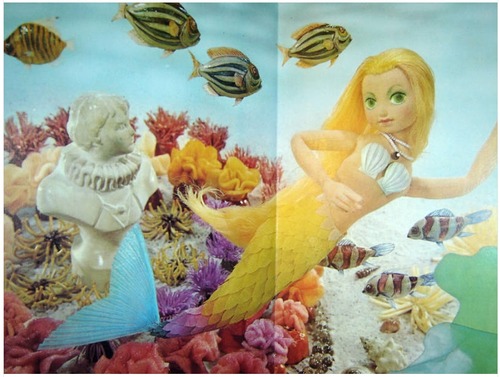
For the next few months, I'll be exploring various myths about Mermaids.
Last month, I talked a little about Hans Christian Anderson's The Littlest Mermaid. While I was digging around my memories of the story and researching to find more details, I discovered a reference to two of the "first" mermaid myths--The Myth of Atargatis--and another similar myth about Thessalonike.
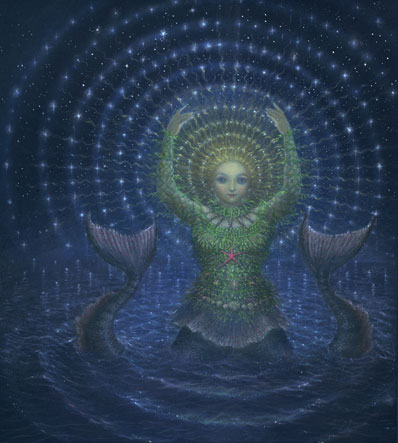 |
| Image by Virginia Lee |
Atargatis is a Syrian or Aramaic goddess. Several sources call her the mermaid goddess. She was a fertility and protective goddess. One popular myth involves her falling in love (or being cursed to love) a human male. When he dies (or disappears), she casts herself into a lake to become half-human/half-fish. Her followers will not eat fish nor doves (doves are sacred to her daughter).
 |
| Image Source - Greek Reporter |
It is said that Alexander the Great bathed his half-sister, Thessalonike's hair with water that would make her immortal. When he died, Thessalonike was so stricken with grief, she threw herself into the sea and became a mermaid. It was her tradition to inquire of passing ships: Is Alexander the King alive? Wise sailors would reply: He lives and reigns and conquers the world. Then she would let them pass. Those who did not reply properly would face her wrath in storm and shipwreck.
I have to wonder why she would pose a question to which she knew the answer and then punish those who spoke the truth. Not very sporting of her.
I have to wonder why she would pose a question to which she knew the answer and then punish those who spoke the truth. Not very sporting of her.
I am fascinated by the fact that both of these "original" mermaid stories are not that far from Hans Christian Anderson's mermaid story. (Obviously he did his homework too, eh?) Both cast themselves into the sea to die, or transform and the impetus--love. If I can lead you one step further, I would offer the observation that the sea these female representations are throwing themselves into can be viewed as a representation of emotions (represented by the element of water). And they all lose themselves in the sea of their emotions, becoming something else all together. I leave it to you to decide if that's a good thing or a bad thing, for them or for us.
Well, I'll end it here and welcome your comments. Please come back next month when I'll be exploring another batch of mermaid myths here at Myth Perceptions.
 Denise Golinowski is a reader and writer of fantasy and romance. Her newest enovella, Collector's Item, is available from The Wild Rose Press
Her first enovella, The Festival of the Flowers: The Courtesan and the Scholar is also available through the Wild Rose Press. You can visit her blog at Golinowski's Gambol.
Denise Golinowski is a reader and writer of fantasy and romance. Her newest enovella, Collector's Item, is available from The Wild Rose Press