Showing posts with label Denise Golinowski. Show all posts

Thursday, October 17, 2013

Merrow, not meow - Mermaid Myths Continued

Hi! Thank you for dropping in to Myth Perceptions where I'm sharing with you various myths and legends I've discovered while researching for my fantasy writing!

Sorry I'm late posting this month, friends. Continuing my research into mermaid myths around the world, I actually encountered a new "to me" myth - the Irish Merrow, thanks to one of my fav paranormal authors, Seanan McGuire.


In "One Salt Sea", half-fae heroine, October Daye, helps solve a kidnapping case involving the two sons of a Merrow and land Fae. If you haven't read any of the October Daye series, you should give it a serious look. You'll learn a LOT about the fae and October is an amazing character! 


So, what's a Merrow? A Merrow is an Irish mermaid or merman. Like most of the merpeople around the world, merrow are human looking from the waist up, fish from the waist down. The Merrow have a comb parting their green hair along crest of their heads and pale webbing between their fingers. They always wear magical red caps made, interestingly enough, of feathers. The cap is called a cohuleen druith which enables them to dive beneath the waves to return to their homes. The merrow often leave the sea to travel about on land, sometimes as small hornless cows or as lovely women wrapped in red capes. Without their cohuleen druith, they are stuck on land, making the caps their weakness. (I could find no explanation for the reason a mermaid would need help to go beneath the waves, and why a feathered cap.)

It is also said that they appear before storms and can capsize boats with careless disregard for the humans on board. Such actions can range from playfulness to fits of rage, but their fae nature makes them naturally careless of weak mortals.

The mermaids are beautiful creatures and enjoy dallying with human males. In the water, they can be wild and careless, but on land, they are gentle and affectionate, making them excellent targets for fishermen seeking amenable wives. If the cohuleen druith is hidden away, the merrow must stay on land, but if she ever finds the cap, she is inexorably drawn to return to the water, abandoning husband and family, never to return. Even with this threat of possible enslavement, female merrows actively seek human lovers and will lure men under the waves to live in enchanted pleasure.

The mermen are far less attractive with red eyes, rosy piglike noses, and gross bodies. They are said to be overly partial to whisky, hence the red noses and eyes. (This might also explain why female merrows are trolling in human "waters" for lovers, eh?) They will also capture humans, but to serve as slaves.

In conclusion, the merrow seem to combine several mythic forms--mermaid, siren, selkie--into one intriguing package topped with a jaunty red feathered cap.

Next month, I'll conclude the mermaid series with some general observations and conclusions. Hope you'll drop by.

Denise Golinowski is a reader and writer of fantasy and romance. Her newest enovella, Collector's Item, is available from  The Wild Rose Press.


Her first enovella, The Festival of the Flowers: The Courtesan and the Scholar is also available  through the Wild Rose Press. You can visit her blog at Golinowski's Gambol.

Wednesday, September 18, 2013

Let me sing you a song - The Rusalka

Hi! Thank you for dropping in to Myth Perceptions where I'm sharing with you various myths and legends I've discovered while researching for my fantasy writing!

Right now, I'm exploring various myths about Mermaids. Having recently spent a lovely Saturday enjoying a Ukranian and a Polish Festival, I am delighted to now share a Slavic "mermaid" myth--The Rusalkas.

Rusalka
Rusalkas are the Slavic form of mermaids, or naiads. Stories say that they are not creatures of their own, but the ghosts of maidens who die a violent death or suicide. The Rusalkas are described in various ways, sometimes with tails when they are lying in the bottom of rivers or streams, but usually with legs when they leave their watery homes to dance in the fields alongside the water or sit, singing, in trees to seduce young men to their deaths. The stories give them either green eyes or white eyes and long hair of either green or golden hue that is perpetually wet. Often, the Rusalka would leave the water to sit in a tree and sing songs or sit on the dock and comb her hair. Like a fish out of water, the Rusalka cannot live long without it, and it is said that if their hair dried out they would die. Their combs are how they call water to them.

There is a Czech opera about the Rusalka, which shares some similar elements as Hans Christian Anderson's famous story. However, in the opera, it is not the mermaid who dies, but the prince.

The Rusalka are said to be their most dangerous during a festival called Semik or Green Week which occurs on the seventh week after Easter. Traditionally, women would hang ribbons a birch tree as offerings to ward off the Rusalkas and swimming was strictly forbidden during this week. Green Week was also a traditional fertility festival and the birch tree would be "drowned" at the end of the week to bring rains to the fields. A wonderful example of sympathetic magic.

I hope you'll come back next month to find out what other types of mermaids I've encountered in my research. Until then, Blessed Be.

Denise Golinowski is a reader and writer of fantasy and romance. Her newest enovella, Collector's Item, is available from  The Wild Rose Press


Her first enovella, The Festival of the Flowers: The Courtesan and the Scholar is also available  through the Wild Rose Press. You can visit her blog at Golinowski's Gambol.

Thursday, July 18, 2013

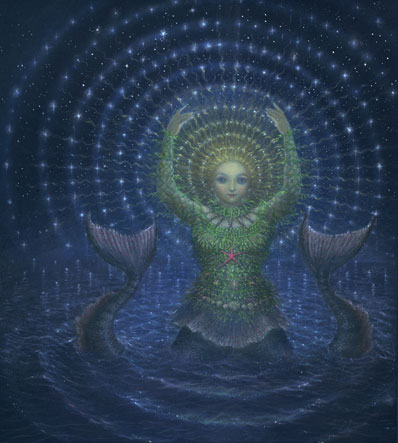
One Fish, Two Fish - Two Ancient Mermaid Myths

Hi! Thank you for dropping in to Myth Perceptions where I'm sharing various myths and legends I've discovered while researching for my fantasy writing, and for you!

For the next few months, I'll be exploring various myths about Mermaids.

Last month, I talked a little about Hans Christian Anderson's The Littlest Mermaid. While I was digging around my memories of the story and researching to find more details, I discovered a reference to two of the "first" mermaid myths--The Myth of Atargatis--and another similar myth about Thessalonike.

Image by Virginia Lee

Atargatis is a Syrian or Aramaic goddess. Several sources call her the mermaid goddess. She was a fertility and protective goddess. One popular myth involves her falling in love (or being cursed to love) a human male. When he dies (or disappears), she casts herself into a lake to become half-human/half-fish. Her followers will not eat fish nor doves (doves are sacred to her daughter).


Image Source - Greek Reporter
Thessalonike is another ancient mermaid myth however my research discovered that she was a historical figure who also has evolved into a myth. Historically, Thessalonike was half-sister to Alexander The Great. During her life, she went from near forgotten daughter to sequestered princess to Queen of Macedonia. It's a very convoluted story, but a fascinating read in the Wiki. The myth is Very Different.

It is said that Alexander the Great bathed his half-sister, Thessalonike's hair with water that would make her immortal. When he died, Thessalonike was so stricken with grief, she threw herself into the sea and became a mermaid. It was her tradition to inquire of passing ships: Is Alexander the King alive? Wise sailors would reply: He lives and reigns and conquers the world. Then she would let them pass. Those who did not reply properly would face her wrath in storm and shipwreck. 

I have to wonder why she would pose a question to which she knew the answer and then punish those who spoke the truth. Not very sporting of her.

I am fascinated by the fact that both of these "original" mermaid stories are not that far from Hans Christian Anderson's mermaid story. (Obviously he did his homework too, eh?) Both cast themselves into the sea to die, or transform and the impetus--love. If I can lead you one step further, I would offer the observation that the sea these female representations are throwing themselves into can be viewed as a representation of emotions (represented by the element of water). And they all lose themselves in the sea of their emotions, becoming something else all together. I leave it to you to decide if that's a good thing or a bad thing, for them or for us.

Well, I'll end it here and welcome your comments. Please come back next month when I'll be exploring another batch of mermaid myths here at Myth Perceptions.


Denise Golinowski is a reader and writer of fantasy and romance. Her newest enovella, Collector's Item, is available from  The Wild Rose Press


Her first enovella, The Festival of the Flowers: The Courtesan and the Scholar is also available  through the Wild Rose Press. You can visit her blog at Golinowski's Gambol.

Wednesday, April 17, 2013

Swanning About Swan Maidens


Hi! Denise Golinowski here with this month's edition of Myth Perceptions.

Continuing with the Shapeshifters World Tour, I've crossed the channel from Scotland to Eastern Europe to explore the myth of the Swan Maidens.

As with most myths we've explored before, there are a variety of swan maiden myths spread across various cultures from Scandanavia to Germany to Japan. However, the majority of myths about Swan Maidens appear to be European in origin.

Pixabay.com

The Swam Maiden myth usually involves lovely magical women wearing swan skins or robes who regularly descend to quiet, isolated pools to shed their feathers and splash about in the waters. They are discovered by a human intruder, and one is captured when the intruder takes possession of her feather skin/robe. As long as the human male holds the robe, the swan maiden must remain with him in human form. Eventually, someone spills the beans about the whereabouts of the robe or the swan maiden finds it. Once she regains possession of her robe, she flies away abandoning the man as well as any offspring they may have engendered.  Click the link beneath this image to read what I found to be one of the most popular versions of the Swan Maiden myth.

From Europa's Fairy Book

Pixabay.com
The myth is most popularly portrayed by the ballet, Swan Lake with one crucial difference. The  man and maiden in this ballet are truly in love and sacrifice themselves in order to stay together.

I especially enjoyed the variety of swan maiden stories contained on this website - http://www.pitt.edu/~dash/swan.html#contents

What I find intriguing about this and some of the other shapeshifting myths is how a magical creature could make themselves so vulnerable as to shed the key to their freedom and then leave it lying around where a covetous human can steal it away from them. I guess when you're a magical creature, you can be as careless as any human, but it seems odd.


If you remove the stupidity factor (sorry, shapeshifters, but I'm calling a spade a spade here), the other fact that captures my imagination is that many of these shapeshifter myths seem to feature beautiful females being captured by human males and forced into marriage/motherhood. Consider selkies, kitsunes, and now swan maidens.

In light of this forced slavery, I am hard-pressed to be upset by the fact that when these females regain possession of their stolen skins, they leave the male without a backward glance. (Okay, there is the issue of their abandonment of their children, but since they are usually magical creatures only temporarily human, the concept of human attachment cannot apply). Heck, I'm surprised the females don't turn on the males in retribution, but perhaps the small, gentle or defenseless animal personas are not pure happenstance, eh? Seals? Swans? Foxes?

What do you think? Heartless Hussies or Escaping Victims?

Well, that's all for this month. Next month will be the final stop on our Shapeshifter World Tour and will bring us back to the Americas with an exploration of Skinwalkers.

Please feel free to leave me your thoughts about some of the questions I've raised or about the Shapeshifter World Tour in general. Or just say hello.

Denise Golinowski is a reader and writer of fantasy and romance. Collector's Item has been released by The Wild Rose Press exclusively on the Kindle and will be available in all electronic formats on May 17th, 2013!

Her first enovella, The Festival of the Flowers: The Courtesan and the Scholar is also available  through the Wild Rose Press. You can visit her blog at Golinowski's Gambol.

Wednesday, January 16, 2013

Werewolves and Shapeshifters

The concept of shapeshifters exists in every culture around the world. They take many forms and obey a diverse set of rules depending upon the specific culture. Since my forthcoming book, "Collector's Item," involves shapeshifters, specifically werejaguars, I thought I'd share a little of my discoveries and ruminations upon the dual-natured in a series of posts.

This first post will deal with my perception of the concepts of  "were" and "shapeshifter."

There is the much discussion about difference between shapeshifters and weres of whatever animal (werewolves, werejaguars, werefoxes). To my mind, shapeshifter is a generic, major classification-type term. It describes the shared trait among the dual-natured - the ability to change their shapes. That said, the weres, selkies, kitsune, etc. are all forms of shapeshifters.

Another thing to note is that shapeshifters have two classes--those who are humans shifting to animal form or animals who shift to human form. Animals who shift into human form more often than not do so for malicious reasons, to prey upon humans in some manner. In the majority of myths involving humans changing into animals, the change has a very negative origin--curses, punishment, flight from an angry god, take your pick. In myths or stories where the change is not one-way/permanent, the "descent" into animal form is nearly always viewed as a "bad" thing.

Werewolves are the ultimate of the bad transitions, and what makes werewolves unique among the shapeshifters is their infamous connection to the moon. Of all the shapeshifters I have encountered in my research, only the werewolves are under the curse of the full moon.

It seems the rest of the shapeshifters are in control of their change, deciding  when and where they shift. Sometimes even choosing "what" they change into when they shift. Not surprising, even shapeshifters who can control their changes are not viewed with anything less than a jaundiced eye. Some are considered truly evil, such as the Native American skinwalkers and the Korean kumiho to name a few, using their abilities to prey upon others.

My werejaguars in "Collector's Item" are not your standard weres. Their transformations are not controlled by the moon and, even more unusual, the jaguar side of my weres have their own personalties and thoughts. The human side is in control, but the animal form is self-aware. Sounds a bit schizophrenic, but in my world, shapeshifters carefully nurture their young, helping them to accept their animal sides in a symbiotic lifestyle. However, the human side is ALWAYS the side in control. It's not an easy thing to accept and some do not gain control of their animal sides. Those who fail are called Unadapted and in "today's" world, they are treated with a drug that suppresses their animal selves completely, enabling the Unadapted to live normal human lives.

Next month, I will share tidbits about some of the Asian shapeshifters. Until then, be careful when you're outside on a full moon. That howl you hear may not be the neighbor's dog.

NEWS FLASH! I'm thrilled to announce that "Collector's Item" will be released by The Wild Rose Press on May 17th!

Denise Golinowski is a reader and writer of fantasy and romance. Her first enovella, The Festival of the Flowers: The Courtesan and the Scholar is available now through the Wild Rose Press. Her second enovella, Collector's Item will also be released by The Wild Rose Press May 17, 2013. You can visit her blog at Golinowski's Gambol.

Wednesday, November 21, 2012

Take a Moment to be Thankful--I Will

Here on the eve of that All American Food Fest called Thanksgiving Day, instead of exploring the world of myths, I'm pondering some "truths" for which I am deeply grateful.

Thanksgiving is not only an opportunity to indulge your love for all things starchy and gravy, thereby inducing the infamous "turkey coma," but also a day for which we should pause and ponder the good fortune of our lives.

This year, perhaps we can all be thankful that the election mayhem is well and truly over. The election commercials have ceased clogging the airwaves. PAC's are no longer stalking our  home phones. And everyone can resume normal life, as we know it.

Then there is our great good fortune to live in this country. All politics aside, we are fortunate to live in the ol' USofA. We can walk our streets in relative safety, no need to fear the whine of incoming missiles. We can go to the local store and are offered a variety of goods that would stagger some. We can worship our higher power of choice without fear of another groups attempting to obliterate us from the face of the earth. We can pursue whatever level of education or knowledge we choose without someone censoring our information or trying to kill us for reaching above our station/race/sex. The list in my heart goes on, but these stand out and I am thankful.

More personally, I am thankful for the multitude of blessings this year. I remain in good health as do all members of my family, far and wide. My son and new daughter-in-law will be blessing our family with a grand-daughter in the coming year. My writing continues to improve and my novella was accepted for publication - Collector's Item coming out in 2013. I have broadened my base of friends and have connected with a wonderful group of talented women to create this blog - Words, Women, Wisdom.

And I continue to have the loving support of a wonderful man, my husband of sixteen years.

So, take a moment tomorrow, before you dive into that Thanksgiving Bonanza and count your blessings. I guarantee it will make the meal all the sweeter.

Happy Thanksgiving and Blessed Be!


Denise Golinowski is a reader and writer of fantasy and romance. Her first enovella, The Festival of the Flowers: The Courtesan and the Scholar is available now through the Wild Rose Press. Her second enovella, Collector's Item will also be published by The Wild Rose Press in 2013. You can also visit her blog at Golinowski's Gambol.

Thursday, November 1, 2012

The NaNoRoundup: Rushing to 50k ... Now!


Today's the first of November. Just a few days more before we turn the clock back. Not far from Thanksgiving. Depending on how you count the days, this is the beginning of the holiday shopping season.

And today's the first day of National Novel Writing Month. NaNoWriMo is a worldwide challenge -- this year, more than 300,000 people are participating -- to write 50,000 words in the month of November. The challenge's few rules are very flexible: writers should be starting new works of fiction, although planning and outlining are permitted. Because it's a self-challenge, the idea is to end up with a reasonably coherent narrative, so there's no upside to writing the same word 50,000 times or copying takeout menus over and over again. At the end of the month, the prizes for completing the challenge include a printable certificate, bragging rights, and most of the first draft of a work of fiction.

This year, a few of us are taking up the challenge and making the long haul to 50,000 words. You can keep track of how we're doing with those little progress bars on the right, and each of us has dropped a comment below to describe our NaNoWriMo projects, other places you can track our progress, and maybe a word or two of NaNoPhilosophy.

Keep an eye on our cheering section over there, and feel free to cheer us on, make us accountable, or join the fun yourself!

Wednesday, September 19, 2012

An Opportunity For Balance--The Autumn Equinox


Mabon, the Autumnal Equinox is this weekend, Saturday, September 22nd. An equinox is when the day and night are in balance, when the light and dark are equal. Saturday is the seasonal shift from Summer to Fall. From Saturday until the Winter Solstice on December 21st, the days will be getting shorter and the nights longer. We will begin withdrawing from the outside world, going inward as the outside temperatures begin to drop. The vibrant, exuberance of summer will recede with the sunlight and the slower, meditative energies of winter will begin to take hold.

Myths abound about this shift, the most familiar being Persephone's return to the Underworld. You remember your mythology class, right? Hades, Lord of the Underworld, became enamored with the lovely Persephone, daughter of Demeter, Greek Goddess of the Harvest. He steals Persephone away to his realm. Demeter goes into mourning over her daughter's disappearance and the earth suffers with her. Eventually, a negotiation takes place and Hades agrees to release Persephone. However, because Persephone consumed a number of pomegranate seeds she must return to Hades for part of the year. Demeter rejoices in the return of her daughter and the earth flourishes – spring/summer. When Persephone returns to the Underworld, Demeter mourns and the earth is abandoned – fall/winter.

It sounds like a horrific and sad story, but I always wonder about the seeds. Persephone is said to understand that anyone who eats anything in the Underworld is bound to stay in the Underworld. And yet, she consumes some pomegranate seeds. Was she tricked by Hades or his minions, or did she eat them willingly because she wanted to stay? There are variations of the myth exploring both sides. I believe she made a conscious choice to eat the seeds, to shift from daughter to mate.

As with all of the equinoxes/solstices, this is a magical opportunity. As the day and night reach parity, consider how the energies of the planet begin to shift. I can feel a slight sense of breathless anticipation, can't you? Like that moment before the roller coaster starts that first drop, or the pause before the see-saw tips. The potential vibrates in the air around us.

Take a moment on Saturday to consider how your life is in or out of balance. What do you need to do to bring more balance into your life? Right now, at this moment, you can begin to balance the scales. You can take in the energetic seeds that will germinate in the cool darkness and bring balance into your life.

Settle yourself in a safe, comfortable place. Close your eyes. Relax and listen. Breathe in the cooling energy of the season. Breathe out the stress in a warm huff. In and out, slowly and smoothly. Imagine yourself standing in a peaceful, comfortable place with the summer sun on your right and the autumn moon on your left. Feel the warm and the cool energies ebb and flow around you, mingling into a single comfortable level. Absorb that energy, accepting the presence of balance into your life. Let the calming energies fill you, balancing you. Take one more deep breath and then slowly open your eyes.

Happy Mabon! Blessed Be!

Denise Golinowski is a reader and writer of fantasy and romance. Her first enovella, The Festivalof the Flowers: The Courtesan and the Scholar is available now through the Wild Rose Press. Her second enovella, Collector's Item will also be published by The Wild Rose Press in 2013. You can also visit her blog at Golinowski's Gambol.

Wednesday, July 18, 2012

Finders Keepers - Losers Weepers


Greetings, Gentle Reader!

This month W3 is all about Summer Vacation. Ah, summer, sun, and surf. There's nothing better than sitting on a blanket with a book, staring out at the waves, and hoping to see a dolphin or two. Grab a patch of sand and join me, won't you?

Wait! Look over there. Something's  bobbing on the waves, just beyond the farthest breaker. Do you see it? Is it just another swell? Or my imagination?

There! A little to the right. A dark shape that doesn't look like water, or a bird, or a dolphin even. Drats! Gone again! Was that a seal?

Selkies

Do not cry into the sea, lassie
Let not your tears meet the waves.
For should the water of your eyes
Meet the waters of the sea
A selkie man will be called to thee.

Selkies are seal shapeshifters, most commonly said to live off the coast of the Orkney Islands and Shetland in Scotland and Co. Donegal in Ireland. The word, "selkie," is old Scots meaning seal, the Irish name is "roan." Similar creatures appear in other coastal mythologies, but let's stay with this, shall we?

When Selkies shed their skins, they transform into beautiful men and women. Beautiful and seductive. And because they always return to the sea, any human who falls under their spell is left bereft. However, should someone find the Selkie's skin and hide it, the Selkie must remain on land with that person until the skin is returned, or they find it.

Stories tell of Selkie women whose skins are taken and hidden by fishermen. The captured Selkie women take the role of wives who live with their fishermen husbands quite docilely, bearing children and minding their homes. However, their hearts truly belong to their sea home and they will never be happy trapped on land. Inevitably in these stories, when the skin is returned or found (which it always is), the Selkie leaves never to be seen again.

The Selkie males were said to be quite handsome and seductive. They are also said to raise storms and overturn boats in retaliation for murdered seals. For some reason, there are fewer stories of captured males. Mostly, the males are blamed for unfaithful wives. The males often came from the sea in search of unsatisfied women and any human woman wishing to call one to her can do so by performing a simple ritual.

At high tide, she should make her way to the shore, where she had to shed seven tears into the sea. – Orkneyjar, The Heritage of the Orkney Islands

The sad and curious thought that someone would be so obsessed with their Selkie lover that they would resort to trapping them to keep them was the inspiration for "By Tears Bound," a short story I wrote and was published by Membra Disjecta in 2008. The short piece of verse above was the first stanza of a "song" I created for the story and I incorporated the "seven tears ritual" as a key part in the plot.

There is also a twist on the legends where some Selkies will lure humans into the sea, never to return.

So, my best advice, never accept a seal-skin coat without asking where it came from. Then again, if the selkie is as attractive as they claim, then you might want to keep it, for a little while. I just advise you not to become too attached to either of them. The Selkies always seem to regain their skin somehow.

Do not cry into the sea, lassie
Let not your tears meet the waves.
For should the water of your eyes
Meet the waters of the sea
A selkie man will steal your heart from thee.

Finders keepers, loser weepers. Until next month, Denise Golinowski

My sweet fantasy romance, The Festival of the Flowers: The Courtesan and The Scholar is available as an ebook from the Wild Rose Press. You can check it out here.